Imperium of Romanus IV Diogenes – Michael Psellus

T

Synopsis:

The Byzantine Empire in the eleventh century was engaged in a power struggle between two parties. The court party was centered in the capital of Constantinople, and was composed of the courtiers, administrative bureaucrats, and urban aristocracy of the metropolis. Rivaling the court party was the military party, which was mostly the agrarian military aristocracy of Anatolia. The military party had been preeminent for about a century prior to the reign of the Emperor Basil II.

The elevation of Romanus IV Diogenes to the throne by the Empress Eudocia was an important victory for the military party, because Romanus was connected with most of the Anatolian military aristocracy, and considered an enterprising, able, as well as skilled general. Romanus was selected as the husband of Eudocia, because the eastern border of the empire was under grave threat from the Seljuk Turks, and even though her own son Michael had already been crowned as Emperor he was young with no military background. The court party preferred weak rulers because of the inbred corruption in the imperial bureaucracy, and for this reason supported Michael.

Michael Psellus was the personal tutor of Michael, and a leading member of the court party. Although a political enemy of the Emperor Romanus IV, Psellus does say some good things about him. However, most of the biography is dedicated to calumny against Romanus in order to justify his betrayal by the supporters of Michael at the battle of Manzikert, which would lead to the ascension of Michael as sole ruler.

Excerpts:

“He affected contempt for the empress, completely despised the officers of state, refused advice, and – incurable malady of emperors – relied on no counsel, no guidance but his own, under all circumstances without exception.

“The fact is, he bore the whole brunt of the danger himself. His action can be interpreted in two ways. My own view represents the mean between these two extremes. On the one hand, if you regard him as a hero, courting danger and fighting courageously, it is reasonable to praise him; on the other, when one reflects that a general, if he conforms to the accepted rules of strategy, must remain aloof from the battle-line, supervising the movements of his army and issuing the necessary orders to the men under his command, then Romanus’s conduct on this occasion would appear foolish in the extreme, for he exposed himself to danger without a thought of the consequences. I myself am more inclined to praise than to blame him for what he did.

“He put on the full armour of an ordinary soldier and drew sword against his enemies. According to several of my informants he actually killed many of them and put others to flight. Later, when his attackers recognized who he was, they surrounded him on all sides. He was wounded and fell from his horse. They seized him, of course, and the Emperor of the Romans was led away, a prisoner…

“The picture they painted was by no means distinct, for each explained the disaster in his own fashion, some saying that Romanus was dead, others that he was only a prisoner; some again declared that they had seen him wounded and hurled to the ground, while others had seen him being led away in chains to the barbarian camp. In view of this information, a conference was held in the capital, and the empress considered our future policy. The unanimous decision of the meeting was that, for the time being, they should ignore the emperor, whether he was a prisoner, or dead, and that Eudocia and her sons should carry on the government of the Empire.

“The commander-in-chief of the enemy forces, when he perceived that the Roman Emperor had fallen into his hands, instead of exulting in his triumph, was quite overcome by his own extraordinary success. He celebrated his victory with a moderation that was beyond all expectation. Offering his condolences to the captive, he shared his own table with him, treated him as an honoured guest, gave him a bodyguard, loosed from their chains those prisoners he cared to name and set them free. Finally, he restored liberty to Romanus himself also, and, after making a treaty of friendship and after receiving from him assurances on oath that he would loyally abide by the agreements they had made, sent him back to Roman territory, with as numerous an escort and bodyguard as anyone could wish for.

*All excerpts have been taken from Fourteen Byzantine Rulers, Penguin Books.

Military Institutions of the Romans – Vegetius

U

Synopsis:

Late antiquity engendered consequential institutional adjustments for Roman arms. The wealth of the state meant that Rome would always attract the best recruits to its standard, but commonly these recruits were foreign mercenaries. Although still effective the army over time became more and more challenging to control because of foreign preeminence.

The Western Roman Empire never solved the problem of the barbarianization of its army, but rather was taken over by it, and collapsed as a state in 476. On the other hand, the Eastern Roman Empire answered the institutional dilemma of barbarianization first by elevating the hard-bitten Isaurian Romans of Anatolia to supremacy over the formerly favored barbarian mercenaries, and later by establishing the militia thémata system.

The late Roman writer Vegetius sought to unravel the institutional riddle of the late Roman army by advancing the thesis of how the ideal Roman army ought to be organized. His work never reflected the reality of late antiquity, but would become influential in the medieval West.

Excerpts:

“Victory in war does not depend entirely upon numbers or mere courage; only skill and discipline will insure it.

“Recruits in particular should be obliged frequently to carry a weight of not less than sixty pounds (exclusive of their arms), and to march with it in the ranks. This is because on difficult expeditions they often find themselves under the necessity of carrying their provisions as well as their arms.

“The courage of a soldier is heightened by his knowledge of his profession, and he only wants an opportunity to execute what he is convinced he has been perfectly taught. A handful of men, inured to war, proceed to certain victory, while on the contrary numerous armies of raw and undisciplined troops are but multitudes of men dragged to slaughter.

“Troops, defenseless and exposed to all the weapons of the enemy, are more disposed to fly than fight.

“To pretend to enumerate the different nations so formidable of old, all which now are subject to the Romans, would be tedious. But the security established by long peace has altered their dispositions, drawn them off from military to civil pursuits and infused into them a love of idleness and ease. Hence a relaxation of military discipline insensibly ensued, then a neglect of it, and it sunk at last into entire oblivion.

*All excerpts have been taken from Military Institutions of the Romans, Praetorian Press, LLC.

The Vandalic and Berber Insurgencies – Procopius

45

Synopsis:

Book IV of The Wars of Justinian by Procopius offers a narrative history of the immediate aftermath of the East Roman victory over the Vandal Kingdom in North Africa by the general Belisarius. Procopius was a witness to some of the events, and offers keen insights into the Vandal as well as Berber insurgencies that followed the departure of Belisarius. The insurgencies the Romans encountered were continuous and had flash-points of high intensity for about ten years.

Dispossessed of their country by the conquest of Belisarius the remaining aggrieved Vandal elite stirred mutiny within the Roman army in North Africa, and utilized puppet Roman commanders in an endeavor to reinstate an independent kingdom. Discerning the dichotomy in the Roman army the Berbers inaugurated their own rebellion, which escalated the atomized landscape. Ultimately, the East Roman army would be victorious and Byzantine North Africa would go on to become a citadel of order as well as prosperity in the following century for the empire.

Excerpts:

“And it came about during this year that a most dread portent took place. For the sun gave forth its light without brightness, like the moon, during this whole year, and it seemed exceedingly like the sun in eclipse, for the beams it shed were not clear nor such as it is accustomed to shed. And from the time when this thing happened men were free neither from war nor pestilence nor any other thing leading to death. And it was the time when Justinian was in the tenth year of his reign.

“In the Roman army there were, as it happened, not less than one thousand soldiers of the Arian faith; and most of these were barbarians, some of these being of the Herulian nation. Now these men were urged on to the mutiny by the priests of the Vandals with the greatest zeal.

“…when they had sailed into Carthage, Germanus counted the soldiers whom they had, and upon looking over the books of the scribes where the names of all the soldiers were registered, he found that a third of the army was in Carthage and the other cities, while all the rest were arrayed with the tyrant against the Romans.

“Solomon sailed to Carthage, and having rid himself of the sedition of Stotzas, he ruled with moderation and guarded Libya securely, setting the army in order, and sending to Byzantium and to Belisarius whatever suspicious elements he found in it, and enrolling new soldiers to equal their number, and removing those of the Vandals who were left and especially all their women from the whole of Libya. And he surrounded each city with a wall, and guarding the laws with great strictness, he restored the government completely. And Libya became under his rule powerful as to its revenues and prosperous in other respects.

“…the Moors did not think it advisable for them to fight a pitched battle with the Romans; for they did not hope to overcome them in this kind of contest; but they did have hope, based on the difficult character of the country around Aurasium, that the Romans would in a short time give up by reason of the sufferings they would have to endure and would withdraw from there, just as they formerly had done.

*All excerpts have been taken from The Complete Procopius Anthology, Bybliotech.

Chronicle of the Fourth Crusade and the Conquest of Constantinople – Geoffrey de Villehardouin

P

Synopsis:

In his Chronicle of the Fourth Crusade and the Conquest of Constantinople, Geoffrey de Villehardouin relates his first-hand account of the evolution of the Fourth Crusade from its original destination of Cairo in Egypt to its eventual conquest of the Christian city of Constantinople. Villehardouin served as a member of the high command of the crusade, and the narrative is written as an attempt to justify its actions. During this era in Byzantine history the population of Constantinople was perhaps 500,000 inhabitants or more, and Villehardouin recounts exceptional wonder at the magnitude as well as opulence of the city.

Excerpts:

“Now you may know that those who had never before seen Constantinople looked upon it very earnestly, for they never thought there could be in all the world so rich a city; and they marked the high walls and strong towers that enclosed it round about, and the rich palaces, and mighty churches of which there were so many that no one would have believed it who had not seen it with his eyes-and the height and the length of that city which above all others was sovereign. And be it known to you, that no man there was of such hardihood but his flesh trembled: and it was no wonder, for never was so great an enterprise undertaken by any people since the creation of the world.

“The Marquis Boniface of Montferrat rode all along the shore to the palace of Bucoleon, and when he arrived there it surrendered, on condition that the lives of all therein should be spared. At Bucoleon were found the larger number of the great ladies who had fled to the castle, for there were found the sister (Agnes, sister of Philip Augustus, married successively to Alexius II, to Andronicus, and to Theodore Branas) of the King of France, who had been empress, and the sister (Margaret, sister of Emeric, King of Hungary, married to the Emperor Isaac, and afterwards to the Marquis of Montferrat) of the King of Hungary, who had also been empress, and other ladies very many. Of the treasure that was found in that palace I cannot well speak, for there was so much that it was beyond end or counting.

“…And the other people, spread abroad throughout the city, also gained much booty. The booty gained was so great that none could tell you the end of it: gold and silver, and vessels and precious stones, and samite, and cloth of silk, and robes vair and grey, and ermine, and every choicest thing found upon the earth. And well does Geoffrey of Villehardouin the Marshal of Champagne, bear witness, that never, since the world was created, had so much booty been won in any city.

“So the host of the pilgrims and of the Venetians found quarters, and greatly did they rejoice and give thanks because of the victory God had vouchsafed to them for those who before had been poor were now in wealth and luxury…And well might they praise our Lord, since in all the host there were no more than twenty thousand armed men, one with another, and with the help of God they had conquered four hundred thousand men, or more, and in the strongest city in all the world – yea, a great city – and very well fortified.

“Well may you be assured that the spoil was very great, for if it had not been for what was stolen and for the part given to the Venetians, there would have been at least four hundred thousand marks of silver and at least ten thousand horses one with another. Thus were divided the spoils of Constantinople, as you have heard.

*All excerpts have been taken from Chronicle of the Fourth Crusade and the Conquest of Constantinople, A Public Domain Book.

The Byzantine Art of War: Strategy and Tactics – Michael J. Decker

33

Synopsis:

Chapter five of Michael J. Decker’s book on the Byzantine art-of-war recounts the strategy and tactics used by the Byzantine Empire throughout its long history. Decker discusses the stratagems, imperial ideology, and organization of the Byzantine state apparatus centered in its capital city of Constantinople. Following the conquest of Constantinople by the Fourth Crusade in 1204 this apparatus was irrevocably destroyed by the Latin West, and even after the reconquest of the city by the Greeks it was never again on the same order of magnitude or effectiveness as before.

Excerpts:

“…All wars were defensive. Even offensive campaigns were considered defensive, in that they aimed to recover land that had been seized from the empire and rightfully belonged to it, and this notion of the ‘forward defense’ or ‘active defense’ was something that the Romans probably imparted to Muslim jihad theorists.

“Experience taught the emperors that any period of peace was fleeting; never did this come into such sharp clarity more than in the events of the late 620s and 630s, when Heraclius found himself at the top of the wheel of fortune with his victories over the Persians, symbolized by his triumphant entry into Jerusalem in a spirit of millennial jubilation. The wheel turned, however, and within a decade Arab forces seized the whole of the Levant.

“Since the reign of Constantine I, the Romans had understood that the universe was ordered according to the principles of Christianity and the world was a reflection of the unseen cosmos:one God, one faith, one emperor, one empire.

“Subterfuge, bribery, and disinformation were prized bloodless means to undermine or dissolve enemies and were always preferred to open battle. The military manuals instruct, whenever possible, to bribe enemy commanders. Before campaigns on the frontiers, the general Nikephoros Ouranos (ca. 950-1011) ordered that gifts be sent to the emirs along the border in order for the bearers to collect intelligence and possibly induce the enemy to the Byzantine side or at least inaction in the coming conflict.

“The handbooks stress the need to surprise the enemy. Strategic surprise could be achieved by avoiding enemy agents, by disinformation, and by unexpected marches. The Strategikon warns that to avoid enemy spies armies should take little-used routes and march through uninhabited areas that were less likely to be under surveillance.

*All excerpts have been taken from The Byzantine Art of War, Westholme Publishing.

Antiochus the Great – Michael Taylor

Synopsis:

Overlooking the swelling power of the Roman Republic in the Mediterranean, the late Seleucid Empire of Antiochus III posed a strategic obstacle to Roman expansion into Greece as well as the Eastern Mediterranean. In order to lead the Roman Republic in peace it was absolutely necessary for a Roman aristocrat to lead in war, and the fanatically competitive nature of the Roman aristocracy meant that Hellenistic autocrats such as Antiochus became an endangered species during the era of Roman ascendancy.

In his biography of Antiochus III ‘the Great’ of the Seleucid Empire Michael Taylor chronicles the politics, wars, conquests, and defeats of the Megas Basileus (Great King) of the Seleucid Empire.

Excerpts:

“…unprecedented warfare had reduced a divided international system to two powers. The two victors saw each other across a ‘contested periphery’, territory that both sides claimed as spheres of influence: Greece in the case of Rome and Antiochus, Central Europe in the case of the US and Stalin. In both instances diplomacy was terse and generally ineffective.

“Antiochus III knew that moving an army into Greece to ‘settle affairs between the Aetolians and Romans’ would lead to war with Rome. Antiochus had not sought such a war willingly, but he was no pacifist. With most of his royal career dominated by military operations, there was little reason for him to flinch from this new challenge.

“The facts that Hannibal relayed were likely encouraging: the Roman army was an amateur militia commanded by amateur aristocrats. It had no standing units, but rather each year fresh recruits were distributed into legions. Half of the army was composed of ‘allied’ wings; these soldiers lacked citizenship. As Hannibal had proved, the Roman army had suffered stunning defeats, due mostly to the combination of poorly trained levies and inexperienced or even incompetent generals. At best, a Roman consul had one or two years of provincial command as a praetor or pro-praetor; Antiochus III had commanded armies for thirty years. While the Seleucid army also contained citizen militiamen in the phalanx, it also had a splendid professional corps, the 10,000 Silver Shields, and the two regiments of royal cavalry. Thus, despite recent Roman successes against Carthage and Macedonia, Antiochus entered the war confident of victory.

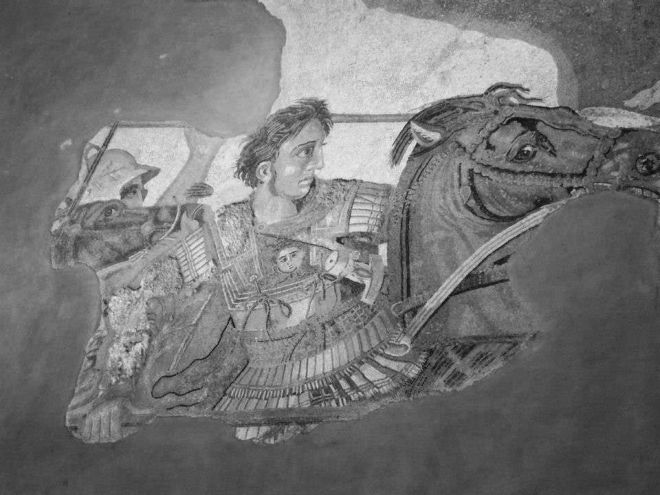
“Almost all Hellenistic kings were obsessed with the physical image of Alexander, the ultimate role model and prototype for Hellenistic kingship. Before Alexander, a copious and virile beard was the sign of a mature Greek man. But Alexander had died before he reached the age where it was customary for Greek men to grow a beard, and his youthful clean-shaven state was copied by his successors even into old age. As a result, beards went out of fashion in the Mediterranean for the next 450 years.

“The Romanophile Antiochus IV met the Roman delegation as it disembarked at Pelusium and affably offered to shake hands. This was a gesture of tremendous respect and good will. In a spectacular and arrogant gesture of showmanship, Popilius Laenus remained silent. He took his staff, drew a circle in the sand around the King, and handed him a written copy of Roman demands. Finally speaking, he told the King not to step out of the circle until he had agreed to Roman demands, demands that included the complete evacuation of Egypt. Antiochus IV was humiliated. But a fellow Hellenistic monarch had just been deposed by Rome, making manifest the potential cost of defeat. He told Laenus of his decision to comply and swiftly withdrew his forces.

*All excerpts have been taken from Antiochus the Great, Pen and Sword.

Justinian’s Military Organization – Hans Delbrück

Synopsis:

In the second volume of his History of the Art of War, Hans Delbrück devotes a chapter in book three to the military organization of the early Byzantine/Late Roman Empire under the emperor Justinian. He examines the dissolution of discipline within the ranks, as well as the transition to a generally cavalry centered army. This more mobile force than the famous legions of previous epochs – particularly the Republican one – was the culmination of centuries of evolution within the Roman army that had commenced under the emperor Gallienus. The resultant innovations from this transformation gave Justinian the edge in escalation dominance over the Barbarian kingdoms in the West, and would open-the-door to a Roman re-conquest of North Africa, Sicily, and the Italian peninsula – all within the span of forty years.

Excerpts:

“The active armies were quite small. Belisarius had 25,000 men when he won his victory over the Persians at Daras in 530. He landed in Africa with no more than 15,000 men, and of these 15,000, the 5,000 cavalry included in that total were sufficient to defeat the Vandals in the open field. Even smaller was the army with which Belisarius moved to Italy in order to destroy the East Gothic Kingdom eleven years after Theodoric’s death: there were no more than 10,000 to 11,000 men.

“A contemporary author, Agathias (5. 13), estimated that the total Roman army must have been 645,000 men strong but that only 150,000 men were actually available under Justinian.

“A very large number of the soldiers with whom Belisarius had conquered Italy deserted to the Goths when, after he was relieved, the Roman domination again collapsed and Totila established the Gothic kingdom.

“After the fourth century A.D., and after the disappearance of the legions, everything changed. The barbarian mercenaries now felt that they were the masters. Woe to the prince or the general who might have dared to incur their displeasure by his strictness!

“Procopius considers it a half-miracle and an extraordinary accomplishment of Belisarius that the Romans marched into Carthage in good order, ‘whereas otherwise the Roman troops never march into their own cities without disorder, even if there are only 500 of them.

*All excerpts have been taken from History of the Art of War, Volume II: The Barbarian Invasions, Hans Delbrück, University of Nebraska Press.